Time Travel in English Grammar: Mastering “It is time” and “It is high time”
Updated: Jun 24

Welcome back to our grammar blog! Today, we are looking at one of those quirky English grammar rules that often leaves both learners and native speakers scratching their heads.
Have you ever heard someone say, "It is high time we left," and wondered why they used the past tense "left" when they are talking about leaving right now?
Let's dive into the fascinating concept of the "Unreal Past" and decode exactly how to use phrases like "It is time" and "It is high time."
The Golden Rule of "It is high time"
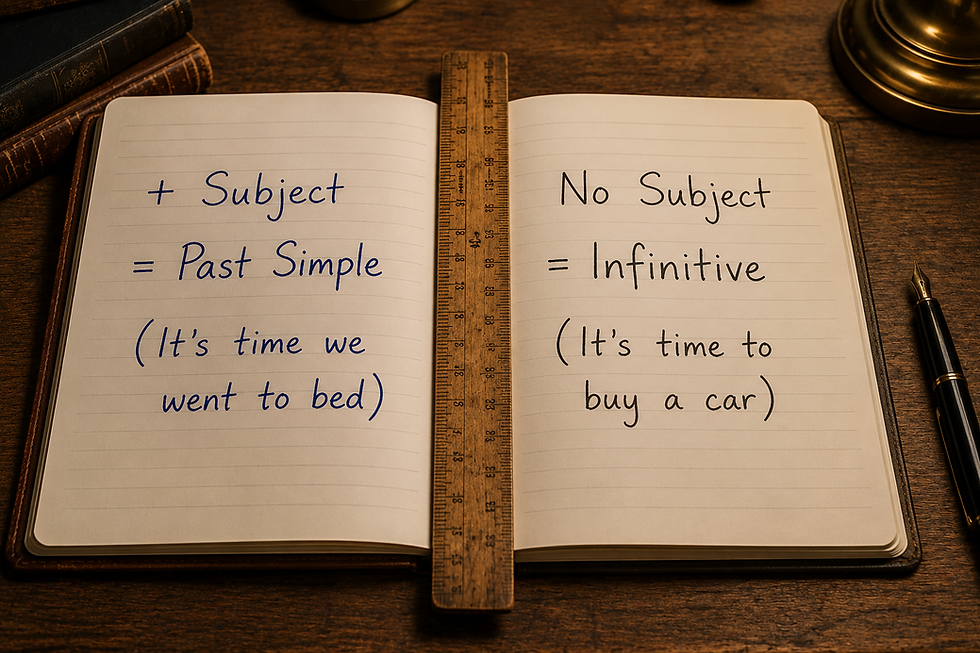
The rule itself is quite straightforward: When the phrases "It is time" or "It is high time" are followed immediately by a subject (such as a noun or a pronoun), the verb that comes next must be in the Past Indefinite (Simple Past) tense.
For example:
"It is time we went home".
"It is high time you got a job".
The "Why": Understanding the Unreal Past
You might be asking, "Why use a past tense if the action hasn't happened yet?"
This is because a past tense verb does not always have a past meaning. In this specific grammatical structure, the past tense refers entirely to a present or future situation. Grammatically, this is known as the "Unreal Past".
We use this specific structure to imply that it is late, and the action should have already been completed by now. By shifting the verb into the past tense, you are expressing a strong suggestion, advice, or a sense of urgency. When you use "It is high time," (which is particularly common in British English), it emphasizes that the situation is incredibly urgent.

Real-World Examples
Let's look at how the past tense structure translates into its actual, present-day meaning:
Structure: "It is time we went home."
Meaning: It is time for us to go home right now.
Structure: "It is high time we left."
Meaning: It is the proper time for us to leave, and we are running late.
Structure: "It's time you washed those trousers."
Meaning: You need to wash those trousers immediately.
The Exception: When NOT to use the Past Tense
There is one major exception to this rule. If the phrase "It is time" is not followed by a subject, you do not use the past tense. Instead, you use a standard to-infinitive.
Compare these two correct sentences:
With a subject (Past Indefinite): "It's time she went to bed."
Without a subject (To-Infinitive): "It's time to buy a new car."
If you want to say who should do the action without putting them directly as the subject, you can use the structure for + object + infinitive:
"It's time for her to go to bed."
Summary for your next writing assignment: The next time you want to tell someone to hurry up and start a project, remember not to say, "It is high time you are starting." Instead, use the Unreal Past to give your sentence that urgent, native-level punch: "It is high time you started!"
Have a grammar rule that always confuses you? Let us know in the comments below and we might cover it in our next post!
What is the unreal past?
The unreal past is a grammatical concept where a past tense verb is used to describe a situation that is imaginary, improbable, or contrary to fact in the present or the future. When using this structure, the verb tense shifts backward to "distance" the language from reality.
There are two main levels to the unreal past:
The Unreal Present/Future: We use the simple past tense to express something that is not true right now. For example, in the sentence "If I had the money now I'd buy a car," the verb had is in the past tense, but it refers entirely to a present lack of money.
The Unreal Past: To describe an imaginary situation that did not actually happen in the past, we shift the tense back even further and use the past perfect tense. For example, "If you had asked me, I would have told you" refers to an unfulfilled condition in the past.
As we covered in our previous conversation, the unreal past is triggered by specific phrases and structures. The most common ones include:
It is (high) time: Used with a subject and a simple past verb to express urgency or a strong suggestion that an action should have already been completed. For example, "It is high time we left" means it is the proper time to leave right now.
Wish and If only: Used with the simple past to express a present desire or regret (e.g., "I wish I had a better memory" or "If only I knew how to ski"). If you want to express a regret about the past, you must use the past perfect (e.g., "I wish you had told me the truth").
Would rather: Used to indicate a preference for what someone else should do (e.g., "I'd rather you came tomorrow").
Suppose / Imagine: Used to propose hypothetical scenarios (e.g., "Suppose we were rich").
As if / As though: Used to make hypothetical or untrue comparisons (e.g., "You look as if you were just about to scream").


Comments