The Ultimate Guide to Literary Devices: Meaning, Types, Examples, and How Writers Use Them
Updated: May 24

Literature is not merely about telling a story — it is about how the story is told. A simple sentence can become unforgettable when a writer adds rhythm, imagery, symbolism, irony, or repetition. These artistic techniques are called literary devices.
From the poetry of William Shakespeare to the speeches of Martin Luther King Jr., literary devices shape emotion, deepen meaning, and make language memorable.
Whether you are a student preparing for exams, a teacher designing lessons, or a writer polishing your craft, this complete guide will help you understand literary devices clearly and confidently.
What Are Literary Devices?
Literary devices are special techniques writers use to create effects, convey ideas, and engage readers. They help writers:
create vivid images,
emphasize important ideas,
produce rhythm and sound,
express emotions,
add hidden meanings,
and make writing more powerful.
A sentence like:
“The wind whispered through the trees.”
is more artistic than simply saying:
“The wind blew through the trees.”
The first sentence uses personification, giving human qualities to the wind.
Why Are Literary Devices Important?
Literary devices help readers:
visualize scenes,
feel emotions,
understand themes,
remember lines,
and interpret deeper meanings.
They also make writing:
more persuasive,
more musical,
more dramatic,
and more beautiful.
Without literary devices, literature would sound flat and mechanical.
Main Categories of Literary Devices
Literary devices can be grouped into several broad categories:
1. Sound Devices
2. Imagery and Comparison
3. Contrast and Repetition
4. Word Play and Figurative Language
5. Irony and Tone
6. Symbolism and Meaning
7. Structural Devices
Let us explore them one by one.

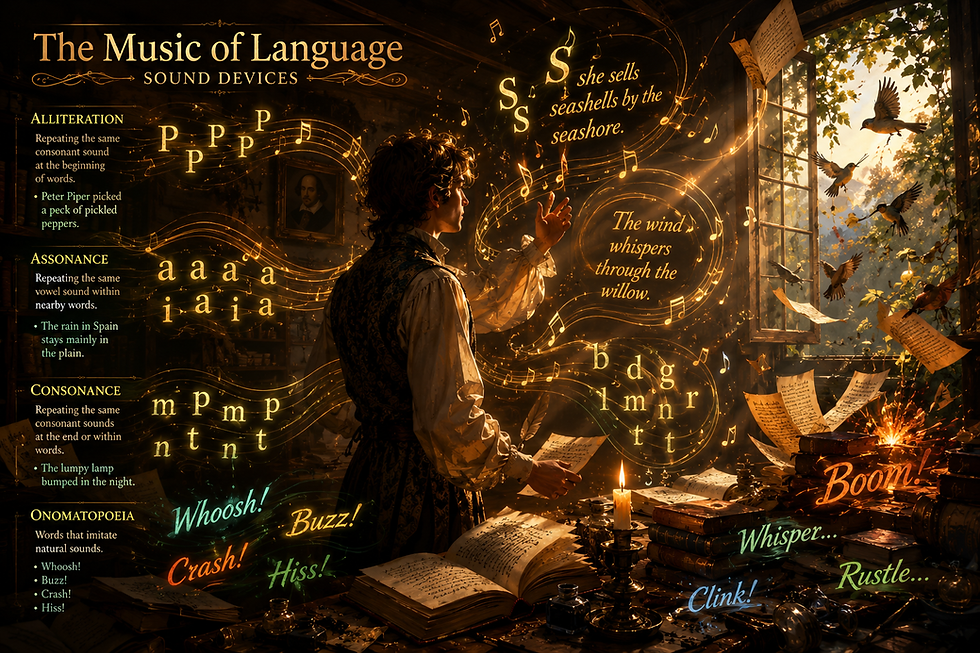
1. Sound Devices
Sound devices create musical effects in writing, especially in poetry.
Alliteration
Alliteration is the repetition of the same consonant sound at the beginning of nearby words.
Example
“She sells seashells by the seashore.”
Effect
Creates rhythm
Makes lines memorable
Adds musical quality
Famous Example
From Beowulf:
“Grendel gongan”
Assonance
Assonance is the repetition of vowel sounds within words.
Example
“The rain in Spain stays mainly in the plain.”
Effect
Creates harmony
Produces internal rhythm
Consonance
Consonance is the repetition of consonant sounds within or at the end of words.
Example
“Pitter patter”
Onomatopoeia
Onomatopoeia occurs when words imitate sounds.
Examples
buzz
hiss
crash
whisper
boom
Effect
Makes writing vivid and realistic.
Example in Poetry
From Alfred Lord Tennyson:
“The moan of doves in immemorial elms.”
2. Imagery and Comparison
These devices help readers imagine scenes vividly.
Simile
A simile compares two unlike things using “like” or “as.”
Examples
“As brave as a lion”
“Her smile was like sunshine.”
Purpose
Creates clear mental pictures.
Metaphor
A metaphor directly compares two things without using “like” or “as.”
Example
“Time is a thief.”
Meaning
Time steals moments from life.
Famous Example
From William Shakespeare:
“All the world’s a stage.”
Personification
Personification gives human qualities to non-human things.
Examples
“The stars danced.”
“The angry storm attacked the village.”
Effect
Makes descriptions emotional and vivid.
Hyperbole
Hyperbole is deliberate exaggeration.
Examples
“I’ve told you a million times.”
“This bag weighs a ton.”
Purpose
Adds humor or emphasis.
Imagery
Imagery uses descriptive language appealing to the senses.
Types of Imagery
Visual imagery
Auditory imagery
Tactile imagery
Olfactory imagery
Gustatory imagery
Example
From John Keats:
“Season of mists and mellow fruitfulness.”
Readers can almost see and feel autumn.

3. Contrast and Repetition Devices
These devices highlight ideas through opposition or repetition.
Anaphora
Anaphora is repetition at the beginning of successive clauses.
Example
From Martin Luther King Jr.:
“I have a dream…”
Repeated many times for emphasis.
Effect
Creates emotional power and rhythm.
Repetition
Repetition means repeating words or phrases intentionally.
Purpose
Emphasis
Rhythm
Emotional intensity
Juxtaposition
Juxtaposition places contrasting ideas side by side.
Example
“Rich and poor lived on the same street.”
Effect
Highlights differences sharply.
Oxymoron
An oxymoron combines contradictory words.
Examples
deafening silence
bittersweet
cruel kindness
Paradox
A paradox appears contradictory but contains truth.
Example
“Less is more.”
4. Word Play and Figurative Devices
Euphemism
A euphemism replaces harsh expressions with softer ones.
Examples
“Passed away” instead of “died”
“Economical with the truth” instead of “lying”
Pun
A pun is wordplay based on double meanings.
Example
“A bicycle can’t stand alone because it is two-tired.”
Idiom
An idiom has a meaning different from its literal meaning.
Examples
“Break the ice”
“Hit the books”
Apostrophe
Apostrophe addresses someone absent or something non-human.
Example
“O Death, where is thy sting?”
5. Irony and Tone
Verbal Irony
The speaker says one thing but means another.
Example
Saying “Lovely weather!” during a storm.
Situational Irony
What happens is opposite of expectations.
Example
A fire station burns down.
Dramatic Irony
The audience knows something the characters do not.
Famous Example
In Romeo and Juliet, the audience knows Juliet is alive while Romeo believes she is dead.
Foreshadowing
Foreshadowing gives hints about future events.
Example
Dark clouds before tragedy.
Purpose
Builds suspense.

6. Symbolism and Deeper Meaning
Symbolism
A symbol represents something beyond its literal meaning.
Common Symbols
Dove → peace
Red rose → love
Darkness → evil or mystery
Famous Example
In Animal Farm, animals symbolize political groups.
Allegory
An allegory is a story with a hidden moral or political meaning.
Example
The Pilgrim's Progress
Motif
A motif is a recurring image, idea, or symbol.
Example
Light and darkness recurring throughout a novel.
7. Structural Literary Devices
Flashback
A flashback interrupts present events to show the past.
Purpose
Provides background information.
Cliffhanger
A cliffhanger leaves readers in suspense.
Common in
detective fiction,
television series,
adventure novels.
Foil Character
A foil contrasts with another character.
Example
In Harry Potter and the Philosopher's Stone:
Harry and Draco contrast morally.
Stream of Consciousness
This technique presents a character’s continuous thoughts.
Famous Writers
Virginia Woolf
James Joyce
Literary Devices in Poetry
Poetry heavily depends on literary devices because poems use fewer words to express deep emotions.
Common poetic devices include:
rhyme,
meter,
alliteration,
metaphor,
symbolism,
enjambment.
Example
From Robert Frost:
“Two roads diverged in a yellow wood…”
The roads symbolize life choices.
Literary Devices in Drama
Dramatic writing uses:
dramatic irony,
soliloquy,
aside,
symbolism,
foreshadowing.
Soliloquy Example
From Hamlet:
“To be, or not to be…”
This reveals Hamlet’s inner thoughts.
Literary Devices in Fiction
Novelists use literary devices to:
develop characters,
build themes,
create atmosphere,
control pacing.
Example
Charles Dickens frequently used symbolism and vivid imagery in his novels.
Difference Between Literary Devices and Figures of Speech
Many students confuse these terms.
Literary Devices | Figures of Speech |
Broad category | Subcategory |
Includes structure and style | Mainly language comparison |
Example: foreshadowing | Example: metaphor |
All figures of speech are literary devices, but not all literary devices are figures of speech.
Difference Between Literary Devices and Figures of Speech — Explained in Detail
Many students use the terms literary devices and figures of speech as if they mean the same thing. They are closely related, but they are not identical.
The easiest way to understand the difference is this:
Figures of speech are a part of literary devices.
In other words:
Literary devices are the big umbrella category.
Figures of speech are one smaller section inside that umbrella.
1. What Are Literary Devices?
Literary devices are all the techniques writers use to improve writing and create effects in literature.
These techniques may involve:
language,
structure,
sound,
symbolism,
plot,
narration,
repetition,
suspense,
imagery,
characterization,
and many more elements.
They are used in:
poetry,
novels,
drama,
speeches,
essays,
and storytelling.
Examples of Literary Devices
Literary Device | Purpose |
Foreshadowing | Hints about future events |
Flashback | Shows past events |
Irony | Creates contrast between appearance and reality |
Symbolism | Represents deeper meanings |
Repetition | Adds emphasis |
Alliteration | Creates sound effects |
Imagery | Paints vivid pictures |
Metaphor | Creates comparison |
Dramatic irony | Audience knows more than characters |
Notice something important:
Some devices deal with:
language → metaphor, simile
structure → flashback
plot → foreshadowing
sound → alliteration
meaning → symbolism
So literary devices are a very broad field.
2. What Are Figures of Speech?
Figures of speech are special ways of using language non-literally or creatively.
They mainly depend on:
comparison,
exaggeration,
substitution,
imagination,
unusual expression
.
A figure of speech changes the ordinary meaning of words to create beauty or emphasis.
Examples of Figures of Speech
Figure of Speech | Example |
Simile | “As brave as a lion” |
Metaphor | “Time is a thief” |
Personification | “The wind whispered” |
Hyperbole | “I’ve told you a million times” |
Oxymoron | “Deafening silence” |
Pun | “A bicycle is two-tired” |
All of these focus mainly on creative language use.
3. The Main Difference
Literary Devices = Broad Techniques
Literary devices include:
plot techniques,
sound techniques,
narrative techniques,
symbolic techniques,
structural techniques,
and figures of speech.
Figures of Speech = Language-Based Expressions
Figures of speech mainly deal with:
imaginative wording,
comparison,
figurative meaning,
emotional language.
4. A Simple Analogy
Imagine a school.
The school = literary devices
One classroom inside the school = figures of speech
Or think of a tree:
Literary devices = the whole tree
Figures of speech = one branch
5. Why “Foreshadowing” Is a Literary Device but NOT a Figure of Speech
This is one of the most important distinctions.
Foreshadowing
Foreshadowing gives clues about future events.
Example
In a story:
Dark clouds gather before a tragedy occurs.
This creates suspense.
But notice:
no unusual comparison,
no figurative wording,
no altered meaning of words.
It is a storytelling technique, not a special expression.
Therefore:
✅ Literary device❌ Figure of speech
6. Why “Metaphor” Is BOTH
Example
“The classroom was a zoo.”
The classroom is not literally a zoo.
The writer compares:
noisy students
with
wild animals.
This is:
creative language,
figurative meaning,
imaginative comparison.
Therefore, metaphor is:
✅ Figure of speech✅ Literary device
Because all figures of speech belong to literary devices.
7. Categories of Literary Devices
Literary devices include many areas.
A. Sound Devices
Used for musical effects.
Examples
alliteration,
assonance,
consonance,
rhyme,
onomatopoeia.
Example
“Peter Piper picked a peck of pickled peppers.”
This uses alliteration.
B. Structural Devices
Used in storytelling structure.
Examples
flashback,
cliffhanger,
foreshadowing,
parallelism.
These are NOT usually figures of speech.
C. Symbolic Devices
Used for deeper meaning.
Examples
symbolism,
allegory,
motif.
D. Figures of Speech
This is only ONE category within literary devices.
Includes:
metaphor,
simile,
hyperbole,
personification,
oxymoron,
pun.
8. Important Comparison Table
Aspect | Literary Devices | Figures of Speech |
Meaning | Broad writing techniques | Creative language expressions |
Scope | Very wide | Narrower |
Includes structure? | Yes | No |
Includes plot devices? | Yes | No |
Includes sound devices? | Yes | Sometimes |
Focus | Entire writing effect | Figurative language |
Example | Foreshadowing | Metaphor |
9. Examples from Literature
Example 1 — Literary Device (Foreshadowing)
From Macbeth:
The witches predict Macbeth’s future.
This prepares the audience for coming tragedy.
This is:
suspense-building,
plot-oriented.
So it is a literary device.
Example 2 — Figure of Speech (Metaphor)
From As You Like It:
“All the world’s a stage.”
The world is compared to a stage.
This is figurative language.
So it is:
a metaphor,
a figure of speech,
and therefore also a literary device.
Example 3 — Literary Device (Flashback)
A novel suddenly shows the hero’s childhood.
This changes narrative structure.
It is:✅ Literary device❌ Figure of speech
Example 4 — Figure of Speech (Hyperbole)
“I am so hungry I could eat a horse.”
Exaggeration creates emphasis.
It is:✅ Figure of speech✅ Literary device
10. Everyday-Life Examples
Literary Device Example
A movie shows:
a broken photograph before a relationship ends.
This is foreshadowing.
Figure of Speech Example
Someone says:
“My phone is dying.”
The phone is not literally alive.
This is personification.
11. Why Students Get Confused
Students confuse them because:
many figures of speech appear in literature,
textbooks often teach them together,
both improve writing style.
But remember:
Literary devices are the entire toolkit.Figures of speech are one special set of tools inside it.

12. A Helpful Memory Trick
Remember this sentence:
“Every figure of speech is a literary device, but not every literary device is a figure of speech.”
Like:
Every rose is a flower,
but not every flower is a rose.
13. Quick Identification Guide
Ask these questions:
Does it involve imaginative wording?
Examples:
metaphor,
simile,
hyperbole.
→ Figure of speech
Does it involve plot or structure?
Examples:
flashback,
foreshadowing,
cliffhanger.
→ Literary device only
14. Final Understanding
Literary Devices
These are all artistic techniques used in literature.
They affect:
structure,
sound,
meaning,
language,
emotion,
storytelling.
Figures of Speech
These are specific forms of figurative language that make expression imaginative and powerful.
They mainly affect:
wording,
comparison,
imagery,
emotional impact.
Final Conclusion
Think of literary devices as the entire universe of literary techniques.
Inside that universe, figures of speech form one important constellation focused on creative language and figurative expression.
So:
✅ Metaphor = both
✅ Simile = both
✅ Hyperbole = both
✅ Foreshadowing = only literary device
✅ Flashback = only literary device
✅ Symbolism = literary device (sometimes figurative)
Once students understand this hierarchy, literary analysis becomes much easier and more accurate.
How to Identify Literary Devices
Ask yourself:
Is there repetition?
Is something compared?
Is there exaggeration?
Does the language create imagery?
Is there hidden meaning?
Is there irony?
Practice is the best way to improve identification skills.
Common Mistakes Students Make
Confusing Simile and Metaphor
Simile uses “like” or “as.”
Metaphor does not.
Confusing Irony and Coincidence
Irony involves opposite expectations.Coincidence is merely accidental.
Overusing Devices in Writing
Too many literary devices can make writing artificial.
Good writing balances clarity and creativity.
Tips for Exam Preparation
Memorize Definitions
Learn short, precise definitions.
Learn Through Examples
Examples are easier to remember than definitions alone.
Practice Identification
Read poems and stories actively.
Explain the Effect
Do not only identify the device — explain why the writer used it.
Example:
“The metaphor emphasizes the passage of time.”
Literary Devices Every Student Should Know
Here are the most essential devices:
1. Simile
2. Metaphor
3. Personification
4. Hyperbole
5. Alliteration
6. Symbolism
7. Irony
8. Foreshadowing
9. Imagery
10. Repetition
Mastering these alone greatly improves literary understanding.
Famous Writers Known for Literary Devices
William Shakespeare
Master of metaphor, irony, and wordplay.
John Keats
Known for sensory imagery.
Charles Dickens
Expert in symbolism and characterization.
Emily Dickinson
Used unconventional punctuation and symbolism.
George Orwell
Famous for allegory and satire.
Literary Devices in Everyday Life
We use literary devices daily without realizing it.
Examples:
“I’m starving!” → Hyperbole
“Time flies.” → Metaphor
“Busy as a bee.” → Simile
Advertisements, speeches, songs, and films constantly use literary techniques.
Final Thoughts
Literary devices are the heartbeat of literature. They transform ordinary language into something memorable, emotional, and artistic.
A writer’s mastery of literary devices can:
move readers to tears,
create suspense,
inspire revolutions,
and make stories live forever.
When you begin noticing literary devices, literature becomes richer and more meaningful. Poems gain music, novels gain depth, and speeches gain power.
The next time you read a poem, novel, or speech, look carefully beneath the words — you will discover a world of artistry hidden inside language itself.


Comments