Mastering Nominalisation in English Language: The Secret to Formal and Professional Writing
Updated: Jun 17

Welcome back to our grammar masterclass! We have already spent time exploring complex sentences and the various types of phrases, but today we are diving into a powerful tool for elevating your writing style: nominalisation.
If you have ever wondered how academic and professional writers make their sentences sound so objective, packed with information, and polished, this is their secret weapon.
What is Nominalisation?
In English grammar, nominalisation is the process of turning a verb, an adjective, or even a whole idea into a noun. Put simply, it means expressing a complete idea within a noun phrase rather than using a full clause.
For example, instead of writing a clause with a subject and a verb ("The residents protested"), you can compress that idea into a single noun phrase ("The residents' protests").
Why Use It?
Nominalisation is commonly used in formal writing, such as business reports, essays, academic texts, and newspaper articles. It helps writers express ideas more clearly and objectively.
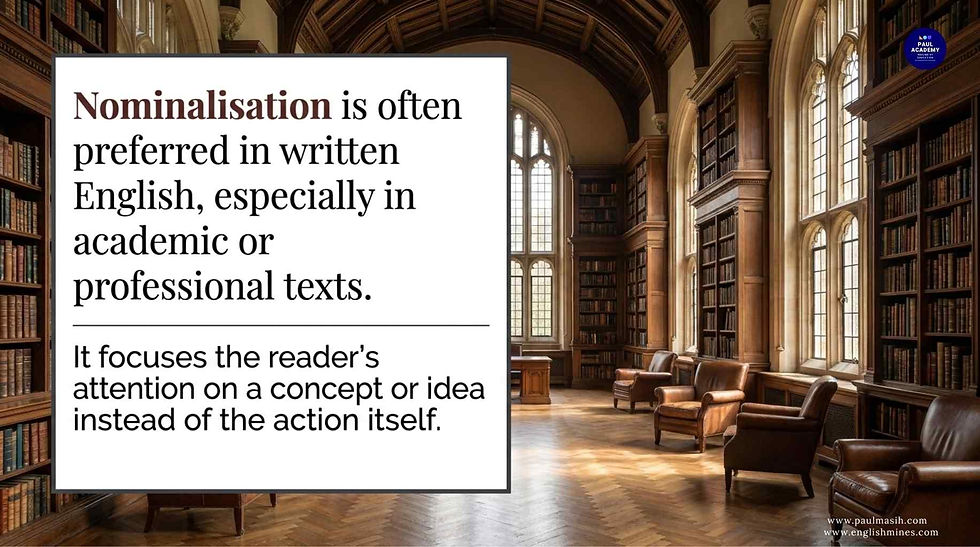
By turning actions (verbs) or descriptions (adjectives) into nouns, you focus the reader's attention on a concept or idea instead of the action itself. In written English, this is often preferred over using multiple clauses because it makes the sentence neater and more authoritative.

How to Form Nominalisations
You can create nominalisations in two primary ways:
1. Changing a Verb into a Noun
You can change an action word into a concept, often by adding common suffixes such as -ance/-ence, -ion/-tion/-sion, -ment, or -al.
Original Clause: The team performed well.
Nominalised: The team’s performance was impressive.
Explanation: In the first sentence, "performed" is a verb telling us what the team did. In the second, the focus shifts to the formal result of the action, the "performance".
More Examples: "Someone published the document" becomes "The publication of the document". "They agreed" becomes "Their agreement".
2. Changing an Adjective into a Noun
You can also nominalise adjectives, typically by using suffixes like -ness, -ity, or -th. This helps your writing sound more formal and idealised.
Original Clause: She was happy with her success.
Nominalised: Her happiness was evident.
Explanation: The adjective describing the person (happy) shifts into a noun representing the feeling itself (happiness).
More Examples: "They are enthusiastic" becomes "Their enthusiasm is obvious".
Grammatical Shifts: The Domino Effect
When you nominalise a clause into a noun phrase, other parts of the sentence must change to fit the new grammatical structure. Here are the three main rules to follow:
1. Subjects become possessives or use "of" The original subject of the clause often turns into a possessive form (using an apostrophe + s) or an of-pattern.
Clause: The visitor departed.
Noun Phrase: The visitor's departure (OR) The departure of the visitor.
2. Adverbs become adjectives Because you no longer have a verb, any adverb that modified the verb must become an adjective to modify your new noun.
Clause: The residents protested angrily.
Noun Phrase: The residents' angry protests were ignored.
3. Objects get a preposition A verb + object combination often turns into a noun + preposition + object. The most common preposition used here is of, but others like in, on, or to are also used.
Clause: Someone attacked the President. -> Noun Phrase: An attack on the President.
Clause: They've changed the law. -> Noun Phrase: A change in the law.
In Conclusion Nominalisation is a fantastic technique to pack a lot of detail into a single phrase and give your writing a professional, academic edge. Next time you edit a report or an essay, look for "action-heavy" sentences and see if turning a verb into a noun gives your writing a stronger impact!

What is a nominalisation in English language?
Nominalisation is the grammatical process of expressing the meaning of a full clause within a noun phrase. It turns verbs (action words) or adjectives (descriptive words) into nouns representing concepts. Instead of writing an active clause with a subject and a verb, the idea is compressed into a single noun phrase.
Does nominalisation increase formality? Yes, nominalisation significantly increases formality.
By converting verbs and adjectives into nouns, it changes the tone of a sentence from an active, action-driven statement into one that is formal, objective, and dense with information. In written English, it is highly preferred in academic, professional, and official contexts to make the writing sound more authoritative.

What is the effect of nominalisation?
The primary effect is that it shifts the reader's attention away from the action itself and onto the concept, idea, or formal result of that action. It helps establish an objective and impersonal tone because it often removes the need to identify the specific person performing the action. Furthermore, it allows writers to compress a great deal of information tightly into a single phrase, making the text denser.
What are three types of nominalisation in grammar?
Based on our previous discussions and grammar rules, nominalisation typically falls into three structural categories:
1. Changing a Verb into a Noun: Shifting the focus to the result or instance of an action (e.g., agree becomes agreement).
2. Changing an Adjective into a Noun: Representing an abstract feeling or quality (e.g., silent becomes silence).
3. Transforming an Entire Clause into a Noun Phrase: Compressing a full subject and predicate into a noun structure (e.g., changing "The landscape is beautiful" to "the beauty of the landscape").
What are nominalization examples?
Here are clear examples showing the transformation from active clauses to nominalised noun phrases:
Clause: "Someone published the document." Nominalised: "The publication of the document."
Clause: "The residents protested." Nominalised: "The residents' protests."
Clause: "The scheme succeeded." Nominalised: "The success of the scheme."
What are the most common nominalizations?
The most common nominalisations are formed by adding specific suffixes to verbs and adjectives to create abstract nouns. These include:
-tion / -sion: decision, discussion, production, correction, information.
-ment: movement, development, agreement, statement, punishment.
-ance / -ence: performance, acceptance, existence, silence, intelligence.
-ness: happiness, illness, freshness, blindness.
-ity / -ty: certainty, stupidity, security, royalty.

How do you identify nominalizations?
You can identify them by looking for action verbs or adjectives that have been converted into nouns. You can spot them visually by looking for the common noun-forming suffixes mentioned above (-tion, -ment, -ance, -ence, -ity, -ness, -al, and -age). Grammatically, you can identify them by looking for phrases where original subjects have been turned into possessives (e.g., the visitor's departure) or where the preposition of is used to connect the new noun to its object (e.g., the departure of the visitor).
Are nominalizations grammatically correct? Yes, they are perfectly grammatically correct. Nominalisation is a standard, highly productive structural feature of the English language that is heavily utilized in formal and academic writing.
Why is nominalisation bad? / Why should technical writers avoid nominalization?
While nominalisation is grammatically correct and useful for formality, it can be highly detrimental to readability if overused. Relying on too many nouns instead of verbs makes writing wordy, sluggish, and dull. For technical writers, the goal is clear, direct, and concise communication. Heavy nominalisation obscures the active participants in a sentence and buries the action. For an effective, engaging writing style, it is recommended to "use verbs rather than nouns to communicate your ideas," because "this makes your writing more forceful and less wordy". For example, instead of the noun-heavy "The advantages of shopping ahead is saving time," you should use the active verb form: "Shopping ahead will save you time".

What is the zombie noun?
Zombie noun" is a humorous, critical term coined by the linguist Helen Sword to describe nominalisations. She calls them "zombies" because they cannibalize active verbs, suck the lifeblood out of a sentence, and reanimate as slow-moving, heavy nouns. For instance, turning the verb "evaluate" into the zombie noun "evaluation" kills the active energy of the sentence, often resulting in overly bureaucratic and tedious writing.
What is another word for nominalization?
In grammar, a word that has undergone nominalisation is often simply called an abstract noun. When the -ing form of a verb is used to function as a noun (e.g., Smoking is injurious), it is specifically called a gerund or a verbal noun.


Comments