There Will Come Soft Rains by Ray Bradbury
Updated: Jul 27
Complete Study Guide: Summary, Analysis, Themes, Characters, Symbolism, Literary Devices & Important Questions (ISC)
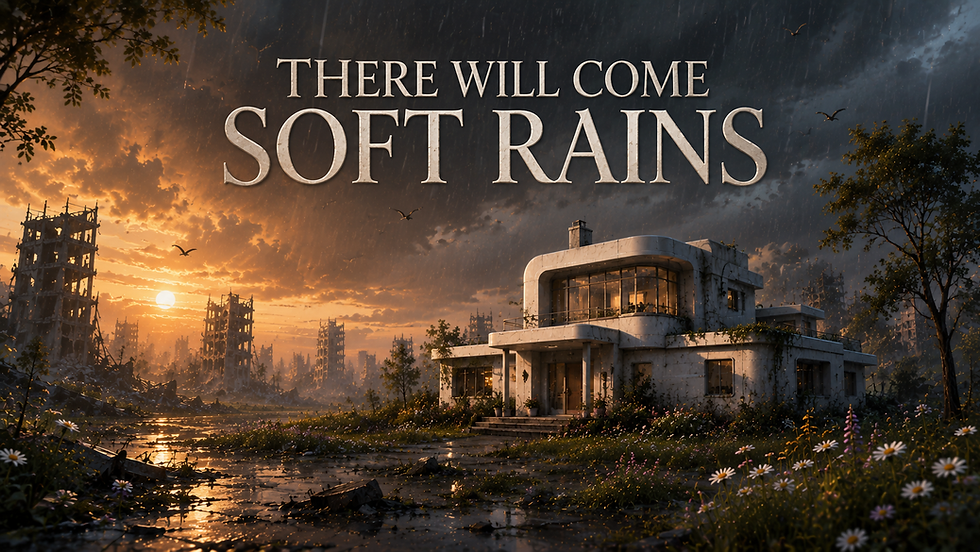
There Will Come Soft Rains by Ray Bradbury
The Complete Study Guide for ISC Students
"There Will Come Soft Rains" by Ray Bradbury is one of the most celebrated science fiction short stories of the twentieth century. More than a tale about a futuristic automated house, it is a powerful warning against humanity's obsession with technology and the devastating consequences of nuclear war. Although the story was first published in 1950, its themes remain remarkably relevant in today's world of artificial intelligence, smart homes, robotics, automation, and global nuclear tensions.
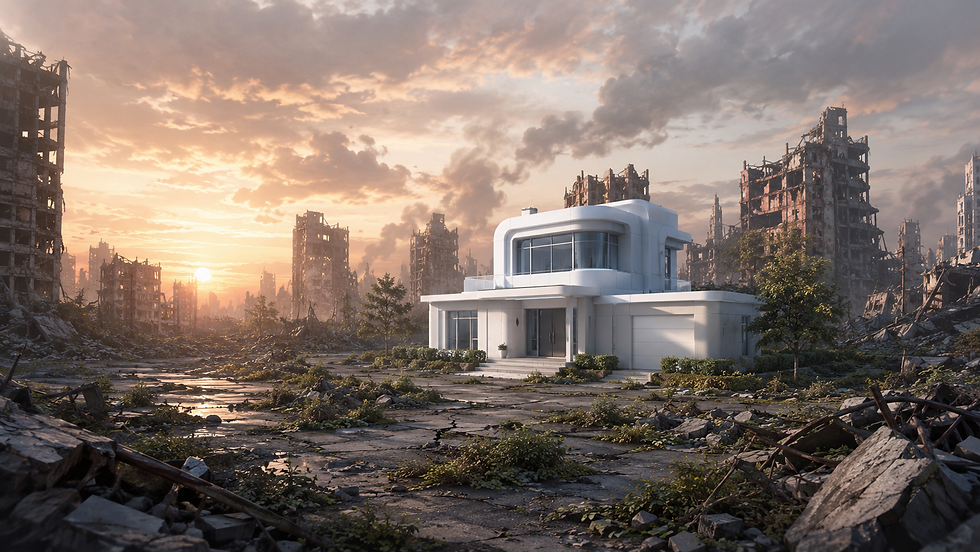
Set in August 2026, the story presents a chilling vision of a fully automated house that continues to perform its daily routines long after its human occupants have been destroyed by a nuclear explosion. The house prepares breakfast, cleans itself, entertains imaginary children, recites poetry, and announces the time with perfect efficiency, completely unaware that there is no one left alive to benefit from its services.
Bradbury masterfully combines science fiction, symbolism, irony, and poetic imagery to convey a timeless message: technology, no matter how advanced, cannot replace human life, emotions, or wisdom. Through the lonely house and its mechanical routines, the author reminds readers that while civilizations may perish, nature continues its eternal cycle without concern for human existence.
This comprehensive study guide has been specially prepared for ISC students, teachers, and literature enthusiasts. It explains every important aspect of the story in clear, examination-oriented language while encouraging deeper literary appreciation.
Download the questions and answers from There Will Come Soft Rains.
Why Should You Study This Story?
This story is included in the ISC syllabus because it goes far beyond entertainment. It encourages students to reflect on important issues that affect modern society, including:
The dangers of nuclear warfare
The limits of technological progress
The ethical use of artificial intelligence
Humanity's relationship with nature
The consequences of excessive dependence on machines
The importance of compassion and human values
Bradbury's vision of the future invites readers to ask an important question:
Can technological advancement truly make life better if humanity destroys itself in the process?
This question remains just as relevant today as it was when the story was written.
Learning Objectives
After studying this lesson, students will be able to:
Understand the complete plot of the story.
Explain the historical background that influenced Ray Bradbury's writing.
Analyse the major themes and ideas presented in the story.
Identify and interpret the symbolism used throughout the narrative.
Recognise important literary devices such as personification, irony, metaphor, imagery, and allusion.
Appreciate Bradbury's unique style of science fiction writing.
Explain the significance of Sara Teasdale's poem within the story.
Answer examination questions confidently using textual evidence.
Develop critical thinking skills by analysing the relationship between technology and humanity.
Quick Facts
Feature | Details |
Title | There Will Come Soft Rains |
Author | Ray Bradbury |
Genre | Science Fiction |
First Published | 1950 |
Setting | Allendale, California, USA |
Time | August 4–5, 2026 |
Narrative Perspective | Third-person narration |
Major Themes | Technology, Nuclear War, Nature, Isolation, Artificial Intelligence |
Important Symbols | The House, Fire, Dog, Mechanical Mice, Silhouettes |
Source of Title | Sara Teasdale's poem There Will Come Soft Rains |

By photo by Alan Light, CC BY 2.0, https://commons.wikimedia.org/w/index.php?curid=1566877
About the Author, Ray Bradbury (1920–2012)
Ray Bradbury was one of the most influential American writers of the twentieth century. Best known for his imaginative science fiction, fantasy, and speculative fiction, Bradbury combined scientific ideas with poetic language and profound philosophical questions.
Unlike many science fiction writers who focused on scientific accuracy, Bradbury used futuristic settings to explore timeless human concerns such as fear, loneliness, war, love, memory, and the consequences of technological progress.
His writing is distinguished by vivid imagery, lyrical prose, and powerful symbolism. Many of his stories warn readers about the dangers of allowing technology, censorship, or political conflict to overshadow human values.
Early Life
Ray Douglas Bradbury was born on 22 August 1920 in Waukegan, Illinois, USA. As a child, he developed a deep love for books, storytelling, and libraries. Since his family could not afford college, Bradbury educated himself by reading extensively in public libraries, which he later described as his true university.
Writing Career
Bradbury began publishing stories in the 1940s and soon established himself as one of America's leading writers of speculative fiction. His works often blur the boundaries between science fiction, fantasy, and literary fiction.
Rather than predicting technological inventions, Bradbury used imagined futures to examine the strengths and weaknesses of human nature.
Major Works
Some of Bradbury's most famous works include:
Fahrenheit 451 (1953)
The Martian Chronicles (1950)
The Illustrated Man (1951)
Something Wicked This Way Comes (1962)
Dandelion Wine (1957)
These works have been translated into numerous languages and continue to be studied worldwide.
Bradbury's Literary Style
Ray Bradbury's writing is characterised by:
Rich poetic language
Vivid sensory imagery
Strong symbolism
Powerful personification
Philosophical themes
Emotional depth
Social criticism disguised as science fiction
His stories often ask readers not merely to imagine the future but to reflect critically on the present.
Bradbury's Concern About Technology
Although Bradbury admired scientific imagination, he repeatedly warned against the blind worship of technology.
He believed that machines should serve humanity rather than replace human relationships, emotions, creativity, and moral responsibility.
There Will Come Soft Rains is one of his clearest warnings about a future in which technological perfection becomes meaningless because humanity has destroyed itself.
Historical Background
To appreciate the full significance of There Will Come Soft Rains, it is important to understand the historical events that shaped Ray Bradbury's imagination. The story was published in 1950, at a time when the world was deeply anxious about nuclear warfare and rapid technological change.
Hiroshima and Nagasaki
On 6 August 1945, the United States dropped the world's first atomic bomb on Hiroshima, Japan. Three days later, a second bomb was dropped on Nagasaki. These explosions destroyed entire cities within moments and caused immense suffering through blast damage, fire, and radiation.
The horrifying images of buildings reduced to ashes and human silhouettes permanently imprinted on walls shocked the world. Bradbury echoes this haunting image in his story through the white silhouettes of the McClellan family burned onto the side of the house.
The Cold War
After the Second World War, relations between the United States and the Soviet Union became increasingly hostile. This period, known as the Cold War, was characterised by political rivalry, military competition, and ideological conflict rather than direct warfare between the two superpowers.
The fear that another global conflict might involve nuclear weapons deeply influenced writers, scientists, and ordinary citizens.
The Nuclear Arms Race
During the 1950s, both the United States and the Soviet Union rapidly developed increasingly powerful nuclear weapons.
Each nation feared falling behind the other, leading to an escalating arms race. Many people believed that a single mistake could destroy civilisation.
Bradbury's ruined city reflects this widespread fear of total nuclear annihilation.
Automation and Smart Homes
The middle of the twentieth century witnessed growing interest in automation. Engineers imagined houses that could cook meals, clean themselves, and perform household chores without human effort.
Bradbury transformed these optimistic ideas into a cautionary tale by asking an important question:
What happens if the machines survive but the people do not?
Artificial Intelligence
Although modern artificial intelligence did not yet exist when Bradbury wrote the story, he imagined machines capable of carrying out complex daily routines with remarkable precision.
The automated house remembers family schedules, prepares meals, entertains children, and even selects favourite poems. However, it lacks genuine understanding or emotional awareness.
Its inability to recognise that its owners have died demonstrates one of Bradbury's central ideas: intelligence without humanity is incomplete.

Title Explanation, Complete Summary, Timeline & Setting Analysis
Why is the Story Titled There Will Come Soft Rains?
The title There Will Come Soft Rains is borrowed from a famous anti-war poem by the American poet Sara Teasdale. At first glance, the title may appear peaceful and comforting because it evokes images of gentle rain and the beauty of nature. However, after reading Ray Bradbury's story, readers realise that the title carries a deep and ironic meaning.
Bradbury deliberately chose this title to emphasise one of the central ideas of his story: nature will continue its eternal cycle even if human civilisation destroys itself through war.
In the story, an automated house faithfully carries out its daily routines after its owners have been killed in a nuclear explosion. The house continues to prepare breakfast, clean the rooms, and announce the time, completely unaware that no human beings remain alive to enjoy these comforts. Outside, the natural world slowly begins to reclaim what humanity has lost.
The title therefore reminds readers that although humans often believe themselves to be the masters of the Earth, nature is ultimately independent of them. Rivers will continue to flow, birds will continue to sing, and rain will continue to fall long after human conflicts have ended.
Thus, the title serves as both a warning and a philosophical reflection on humanity's place in the universe.
The Connection with Sara Teasdale's Poem
One of the most memorable moments in Bradbury's story occurs when the automated house recites Sara Teasdale's poem There Will Come Soft Rains.
The poem was written during the First World War and imagines a world in which humanity has disappeared because of war. Despite the destruction of mankind, nature continues peacefully:
Rain falls gently.
Birds continue singing.
Frogs croak in ponds.
Trees blossom.
Spring returns every year.
Nature neither celebrates nor mourns the disappearance of human beings because it exists according to its own timeless rhythms.
Bradbury uses the poem as a powerful form of allusion—a literary reference that enriches the meaning of the story. While Teasdale imagined humanity disappearing because of war, Bradbury transforms this idea into a futuristic vision of nuclear annihilation.
The poem also creates a striking contrast between the mechanical world inside the house and the living world outside it. The house depends entirely on technology, routines, and electricity, whereas nature continues effortlessly without human intervention.
The final message of both the poem and the story is the same:
Nature is eternal; human civilisation is fragile.
Similarities Between the Poem and the Story
Sara Teasdale's Poem | Bradbury's Story |
Nature survives after war. | Nature survives after nuclear destruction. |
Human beings disappear. | The McClellan family is dead. |
Birds, trees and rain continue normally. | The natural world slowly reclaims the ruined city. |
War becomes meaningless. | Technology becomes meaningless without humanity. |
Nature is indifferent to mankind. | Nature remains unaffected by humanity's extinction. |
Differences Between the Poem and the Story
Poem | Story |
Focuses mainly on nature. | Focuses mainly on technology. |
Uses lyrical poetry. | Uses science fiction prose. |
Imagines the absence of humanity. | Explains how humanity disappeared. |
Calm and reflective. | Suspenseful and tragic. |
Suggests renewal. | Warns against technological arrogance and nuclear war. |

Complete Summary of the Story
Morning: A House Without a Family
The story begins at 7:00 a.m. in a fully automated house located in Allendale, California. An electronic voice repeatedly announces the time and reminds the family that it is time to wake up.
Although the house performs its duties with perfect efficiency, there is one shocking reality: no one answers.
The house prepares breakfast exactly according to schedule. Toast pops out of the toaster, eggs are cooked, bacon sizzles, coffee is poured, and milk is served. Every task is completed flawlessly, yet no family members come to the dining table.
This immediately creates dramatic irony. The readers understand that something terrible has happened, while the house continues its routines as if everything were normal.
The Empty House
Throughout the morning, the house carries out dozens of automated tasks.
It reminds children to go to school.
It asks Mr. and Mrs. McClellan about their appointments.
It cleans the kitchen.
It washes the dishes.
It sends robotic cleaning mice to remove dust.
Every machine behaves exactly as it was programmed, but there are no humans left to benefit from these services.
Bradbury uses these scenes to illustrate the emptiness of a world in which technology survives but humanity does not.
The Outside World
The readers are then shown the outside of the house.
The surrounding city has been completely destroyed by a nuclear explosion. Every neighbouring house has been reduced to ashes.
Only one house remains standing.
On one wall of the house are five white silhouettes burned into the paint.
These ghostly outlines reveal the final moments of the McClellan family:
A man mowing the lawn.
A woman picking flowers.
A boy throwing a ball.
A girl catching it.
The family enjoying an ordinary day.
The tremendous heat of the nuclear blast vaporised their bodies instantly, leaving only their shadows permanently imprinted on the wall.
This haunting image becomes one of the most powerful symbols in the entire story.
The Dog Returns
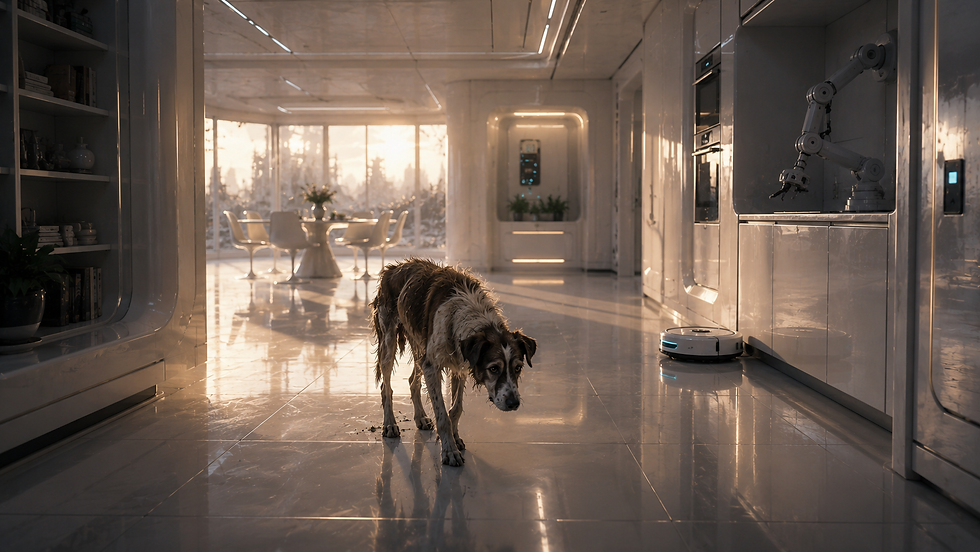
Around noon, the family dog returns home.
The once healthy pet is now thin, exhausted, frightened, and badly injured.
It runs through the empty rooms searching desperately for its owners.
Finding no one, the dog becomes increasingly confused.
It whimpers, howls, and runs from room to room before finally collapsing.
Soon afterwards, the dog dies.
Without emotion or compassion, the mechanical cleaning mice emerge from hidden openings in the walls.
They efficiently dispose of the dead body by carrying it to the incinerator.
Bradbury contrasts the dog's natural loyalty and love with the cold efficiency of the machines.
Afternoon Activities
Despite the family's death, the house continues its programmed schedule.
Bridge tables automatically appear.
Martinis are prepared.
Music begins to play.
The nursery transforms into a magnificent virtual jungle filled with colourful animals.
Lions roar.
Giraffes wander through tall grass.
Butterflies flutter among flowers.
Rain falls softly across the projected landscape.
The nursery provides a vivid display of imagination and technological brilliance, yet there are no children left to enjoy it.
Its beauty only deepens the sense of loneliness.
Evening
As darkness approaches, the house prepares warm baths.
It lays out fresh towels.
Beds are warmed to the correct temperature.
Dinner is prepared.
The family is repeatedly called to eat.
Again, no one responds.
Finally, the house selects a poem requested long ago by Mrs. McClellan.
The voice begins to recite Sara Teasdale's There Will Come Soft Rains.
The poem reminds readers that nature will continue peacefully even if mankind disappears.
Its message perfectly reflects the tragedy unfolding in the story.
The Fire
After the poem ends, a tree branch crashes through the kitchen window during a storm.
A bottle of cleaning solvent is knocked over.
The highly flammable liquid catches fire.
Within moments, flames spread rapidly through the house.
The automated safety systems respond immediately.
Sprinklers release water.
Mechanical snakes shoot green fire-fighting chemicals.
Emergency pumps begin operating.
Doors seal automatically.
Robotic mice race through the rooms.
The house fights desperately to save itself.
For a while, it appears successful.
Eventually, however, the fire becomes too powerful.
The water supply is exhausted.
The pumps fail.
The flames spread uncontrollably.
One room after another is consumed by fire.
The Death of the House
The fire finally reaches the attic, where the electronic brain controlling the house is located.
As the central control system burns, the house begins to lose its ability to function.
Its voices become confused.
Commands are repeated endlessly.
The nursery animals disappear.
The clocks stop.
The walls collapse.
The roof caves in.
The technological marvel that had operated flawlessly throughout the day is reduced to ruins within a few hours.
Bradbury suggests that even the most advanced technology remains vulnerable to the forces of nature.
The End
By dawn, almost nothing remains of the once magnificent house.
Only a single wall still stands.
Attached to it is one surviving voice.
It continues faithfully announcing the date:
"Today is August 5, 2026."
The voice repeats its message again and again to an empty world.
The story ends with profound irony.
The machines continue performing their duties perfectly, but there is no civilisation left to hear them.
Bradbury leaves readers with a timeless warning:
Technology may survive for a while, but without humanity, it has neither purpose nor meaning.
Timeline of Events
Time | Event |
7:00 a.m. | The voice clock wakes the family. |
7:09 a.m. | Breakfast is prepared automatically. |
Morning | Household chores continue. |
Late Morning | The outside devastation is revealed. |
Noon | The family dog returns. |
Shortly After | The dog dies and is removed by mechanical mice. |
Afternoon | Bridge tables appear and martinis are served. |
4:30 p.m. | The nursery becomes a virtual jungle. |
Evening | Baths are prepared and dinner is cooked. |
9:05 p.m. | Sara Teasdale's poem is recited. |
Night | Fire breaks out after a tree branch crashes through the kitchen window. |
Late Night | The house battles the fire but is destroyed. |
August 5, 2026 | Only one wall remains, still announcing the date. |
Setting Analysis
Physical Setting
The story is set in Allendale, California, in a fully automated smart house that has miraculously survived a catastrophic nuclear explosion. While the surrounding city has been reduced to ashes, the house continues to function exactly as it was programmed.
The contrast between the intact house and the devastated landscape creates an atmosphere of eerie loneliness and suspense.
Historical Setting
Although the story takes place in the future (2026), it reflects the fears of the early Cold War era, when nuclear weapons threatened global destruction. Bradbury transforms these real-world anxieties into a futuristic warning about humanity's capacity for self-destruction.
Technological Setting
The house represents a world dominated by automation. Every household task—from cooking and cleaning to entertainment and security—is performed by machines without human assistance. Bradbury's vision anticipated many modern technologies, including smart homes, voice assistants, robotic vacuum cleaners, and automated scheduling systems.
Social Setting
No human society remains. The absence of people is one of the story's most striking features. The routines of family life continue mechanically, but the relationships, emotions, and conversations that once gave those routines meaning have vanished.
Psychological Setting
The emotional atmosphere of the story is one of silence, emptiness, and quiet tragedy. The cheerful voices of the house contrast sharply with the reality of death, creating a persistent sense of irony. As the narrative progresses, the mood shifts from orderly routine to growing tension and finally to complete destruction.
Why the Setting Matters
Bradbury's carefully crafted setting is not merely a backdrop; it reinforces the story's central message. The automated house, standing alone amid the ruins of civilisation, symbolises the paradox of technological progress without humanity. It reminds readers that machines may imitate life, but they cannot replace the people whose lives give technology its purpose.
Characters, Detailed Analysis, Major Themes, Conflict & Artificial Intelligence
Characters
Unlike conventional stories, There Will Come Soft Rains has no living human characters. The McClellan family has already perished before the story begins. Instead, Bradbury personifies machines and natural forces, allowing them to function like characters. This unconventional technique reinforces the story's central message: technology may imitate life, but it can never replace it.
The Automated House
Introduction
The automated house is the central character of the story. Although it is a machine, Bradbury gives it human qualities, making it appear almost alive. It speaks, remembers schedules, performs household duties, protects itself from danger, and continues its daily routines with remarkable efficiency.
Ironically, the house possesses intelligence but lacks awareness. It can prepare breakfast, clean rooms, entertain children, and recite poetry, yet it cannot understand the simple fact that its owners are dead.
Character Traits
Highly efficient
Obedient
Tireless
Organised
Emotionless
Mechanical
Unaware of reality
Self-protective
Role in the Story
The house symbolises the technological achievements of human civilisation. It demonstrates how far science has advanced, but it also reveals the limitations of technology. Despite all its sophistication, it cannot replace the warmth, love, and purpose that human beings bring to a home.
Symbolic Significance
The house represents:
Human civilisation
Scientific progress
Dependence on technology
Human pride
The illusion of permanence
Its destruction suggests that no technological achievement is invincible.
Examination Note
Question: Why is the house regarded as the protagonist of the story?
Answer: The house performs the actions that drive the plot, experiences the central conflict against the fire, and symbolises humanity's dependence on technology. It functions like a living character through Bradbury's extensive use of personification.
The Dog
Introduction
The dog is the only living creature that enters the house during the story. Its brief appearance is one of the most emotionally moving episodes.
Once a beloved family pet, it returns home expecting comfort and affection. Instead, it finds only silence.
Character Traits
Loyal
Faithful
Confused
Weak
Helpless
Vulnerable
Importance
The dog's suffering reminds readers that war destroys innocent life as well as human civilisation. Unlike the machines, the dog experiences fear, loneliness, hunger, and pain.
Its tragic death contrasts sharply with the cold efficiency of the mechanical mice that immediately dispose of its body.
Symbolic Meaning
The dog symbolises:
Loyalty
Human companionship
Innocence
Victims of war
The emotional world absent from machines
The Mechanical Mice
Although they appear only briefly, the mechanical mice perform one of the house's most important functions.
They emerge from hidden openings, collect dust, remove dirt, and eventually dispose of the dog's dead body.
Character Traits
Efficient
Precise
Tireless
Silent
Emotionless
Symbolism
The mice represent complete automation.
They perform their tasks perfectly but without compassion.
Bradbury suggests that machines can imitate actions but never human emotions.
The Voice Clock
The voice clock announces the time throughout the story.
Its cheerful tone contrasts painfully with the empty house.
It repeatedly reminds the absent family about breakfast, school, baths, and bedtime.
Significance
The clock symbolises:
Routine
Habit
Order
Mechanical precision
Its announcements become increasingly ironic because no one remains alive to hear them.
The final voice announcing the date after the house has collapsed becomes one of the most memorable endings in modern literature.
Fire
Fire functions almost like another character.
Initially, it appears as a destructive enemy.
The house struggles desperately to defeat it using sprinklers, chemical sprays, robotic snakes, and emergency pumps.
Eventually, however, the fire overwhelms every defence.
Symbolic Meaning
Fire represents:
Nature's destructive power
Human vulnerability
The limits of technology
Chaos overcoming order
The McClellan Family
Although they never appear alive, the McClellan family remains central to the story.
Readers learn about them through the routines of the house and the silhouettes left on the wall.
Symbolic Meaning
The family represents:
Ordinary humanity
Everyday domestic life
The countless innocent victims of war
Their absence is far more powerful than any dialogue could have been.
Character Relationships
Character | Represents | Importance |
The House | Human civilisation | Central symbol of technology |
The Dog | Loyalty and innocence | Emotional heart of the story |
Mechanical Mice | Automation | Machines without compassion |
Voice Clock | Routine and order | Irony and repetition |
Fire | Nature's destructive force | Defeats technological pride |
McClellan Family | Humanity | Victims of nuclear war |

Detailed Analysis
Bradbury's story is much more than an imaginative tale about a futuristic house. It is a profound meditation on technology, war, civilisation, and the future of humanity. Through symbolism, irony, and personification, the author encourages readers to question their assumptions about progress and human superiority.
Technology: A Marvel Without Meaning
One of the most striking aspects of the story is Bradbury's portrayal of advanced technology.
The house performs every conceivable household task automatically. It prepares meals, cleans rooms, entertains children, regulates temperature, and even reads poetry. Every action is executed with flawless precision.
Yet this perfection is ultimately meaningless because there are no people left to benefit from it.
Bradbury's central argument is that technology is a tool, not an end in itself. Machines can improve human life, but they cannot replace human relationships, emotions, or moral responsibility.
Without people, technology loses its purpose.
Human Pride and Overconfidence
Throughout history, humanity has celebrated scientific achievements as symbols of progress.
Bradbury acknowledges these achievements but warns against excessive confidence in technological power.
The automated house appears almost invincible.
It can clean itself.
Protect itself.
Repair itself.
Fight fires.
Manage daily life independently.
Nevertheless, one falling tree branch begins a chain of events that destroys everything.
The message is clear:
Human beings often overestimate their control over nature.
Nature: The Ultimate Survivor
Nature is one of the story's silent yet dominant forces.
Even after civilisation has disappeared:
Rain continues to fall.
Trees continue to grow.
Animals continue living.
Day follows night.
Seasons continue changing.
Bradbury echoes Sara Teasdale's belief that nature neither depends upon nor mourns humanity.
This idea challenges humanity's tendency to view itself as the centre of the universe.
War: Humanity's Greatest Failure
Although Bradbury never explicitly describes the nuclear explosion, its consequences are visible everywhere.
The destroyed city.
The radioactive glow.
The burned silhouettes.
The absence of human life.
The lonely dog.
The empty house.
These details suggest that mankind has destroyed itself through its own inventions.
Bradbury implies that the greatest danger is not technology itself but the human misuse of technology.
Loneliness and Silence
Perhaps the most haunting feature of the story is its overwhelming silence.
The house constantly speaks.
Machines buzz.
Doors open.
Voices announce schedules.
Music plays.
Yet no human voice ever replies.
This contrast creates an atmosphere of profound loneliness.
The silence becomes a reminder that civilisation is defined not by buildings or machines but by human presence.
Artificial Intelligence as a Central Idea
Although written decades before modern artificial intelligence, There Will Come Soft Rains anticipates many questions that society continues to ask today.
The house demonstrates extraordinary intelligence.
It recognises time.
It remembers routines.
It performs complicated tasks.
It responds to emergencies.
It even selects poetry.
However, intelligence alone is not enough.
The house cannot:
Understand death.
Feel grief.
Adapt to unexpected reality.
Question its programming.
Make moral decisions.
Bradbury distinguishes between artificial intelligence and human consciousness.
Machines may process information with incredible efficiency, but they cannot experience love, compassion, sorrow, or wisdom.
This distinction remains one of the most important debates surrounding AI today.
Major Themes
Technology Without Humanity
The central theme of the story is that technology has value only when it serves human life.
The automated house represents astonishing scientific achievement, yet its routines become meaningless after the death of its owners. Bradbury argues that no machine, however advanced, can replace human emotions, relationships, or purpose.
Destruction Through War
The ruined city and the vanished family reveal the catastrophic consequences of nuclear warfare. Bradbury condemns humanity's willingness to use scientific discoveries for destruction rather than peace.
Nature's Endurance
One of the story's most optimistic ideas is that nature survives even after human civilisation collapses. Rain continues to fall, trees continue to grow, and life follows its natural rhythm, echoing the message of Sara Teasdale's poem.
Artificial Intelligence
Bradbury presents AI as both impressive and limited. The house possesses remarkable computational ability but lacks consciousness, empathy, and independent judgement. The story reminds readers that true intelligence includes emotional and moral understanding.
Isolation and Loneliness
The empty house, the unanswered voice clock, and the wandering dog create an overwhelming sense of isolation. Bradbury suggests that technology cannot cure loneliness when human companionship is absent.
Mortality
The story emphasises that all human achievements are temporary. Even the most advanced house cannot escape destruction, reminding readers of the fragility of both life and civilisation.
Human Arrogance
Bradbury criticises humanity's belief that scientific progress alone guarantees security or superiority. The destruction of the city shows that technological advancement without wisdom can become a force of self-destruction.
Conflict
Although there are no traditional heroes or villains, the story contains several important conflicts that drive its meaning.
Conflict | Explanation |
Humanity vs. Itself | Human beings destroy their own civilisation through nuclear war. |
Technology vs. Nature | The house struggles to survive but is ultimately defeated by fire. |
Routine vs. Reality | The house continues its daily schedule despite the absence of its owners. |
Life vs. Death | Mechanical activity continues in a world where human life has vanished. |
Emotion vs. Mechanism | The dog's grief contrasts with the emotionless efficiency of the machines. |
Critical Appreciation
Bradbury transforms an ordinary household into a powerful symbol of twentieth-century civilisation. By removing human characters from the narrative, he forces readers to recognise the emptiness of a world where technology survives but humanity has perished. The story's enduring relevance lies in its exploration of issues that remain urgent today—artificial intelligence, automation, nuclear weapons, environmental responsibility, and the ethical limits of scientific progress. Its haunting ending reminds us that machines may continue to function, but only human beings can give meaning to the world they create.
Comprehensive Glossery and Study Guide


Comments