Julius Caesar Class 10 DAV: Summary, Paraphrase, Themes and Questions

A warning becomes flattery, a petition becomes a murder, and two speeches turn the same Roman crowd in opposite directions. This guide follows the Julius Caesar scenes in the Class 10 Communicative English reader: Act II Scene II and Act III Scenes I–II.
Contents
What this guide covers
Scene-wise summary and simple paraphrase
Characters, themes and dramatic techniques
Word meanings and CBSE-style literature practice with answers
Download the complete Julius Caesar study material
Download the free 68-page Julius Caesar Class 10 Communicative English study material PDF. It brings together scene-wise summaries and paraphrases, word meanings, themes, CBSE-style practice questions, answers, and a quick revision sheet.
Act II Scene II: Caesar at home

Calpurnia has cried out in her sleep that Caesar is being murdered. She reports unnatural signs and begs him not to leave. The priests also advise caution because the sacrificed animal has no heart. Caesar asserts that death is inevitable and that bravery requires him to face it, yet Calpurnia briefly convinces him to remain indoors.
Plain English: “Cowards die many times before their deaths” means fearful people repeatedly suffer by imagining death. The valiant experience death only when it actually comes. The statement describes an attitude to fear, not repeated physical death.

Calpurnia dreams that Caesar’s statue pours blood while Romans wash their hands in it. Decius calls this a fortunate vision, saying that Rome will draw new strength from Caesar. He claims that the Senate may offer a crown and might reconsider if Caesar stays away. Caesar, ashamed of seeming weak, decides to go. Decius Brutus is not Marcus Brutus, Caesar’s friend and fellow conspirator.
Act III Scene I: the Senate and Caesar’s death
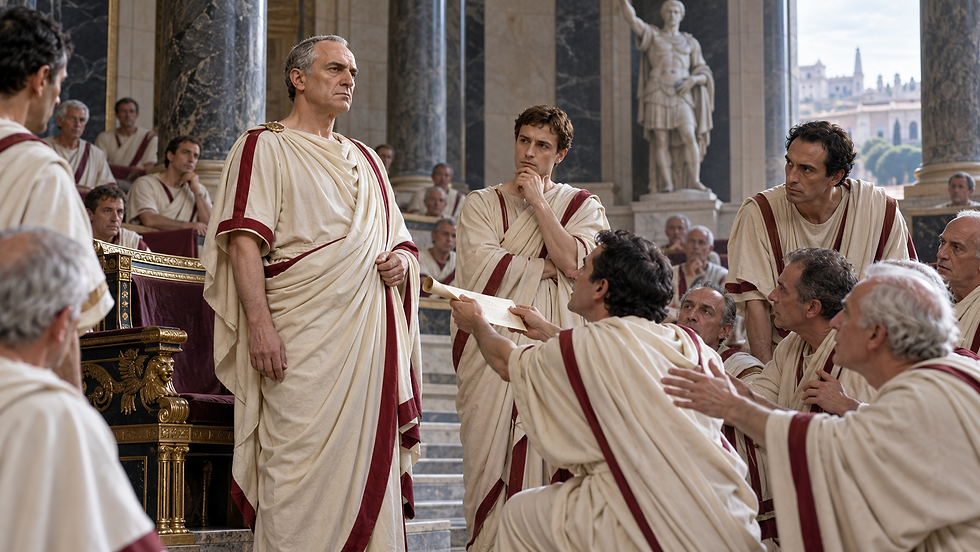
Metellus Cimber asks Caesar to recall his banished brother Publius. Brutus and Cassius support the appeal. Caesar refuses and likens his fixed decision to the northern star. Casca strikes first; the others, including Marcus Brutus, stab Caesar. Caesar’s recognition of Brutus makes the betrayal personally devastating.
Plain English: Caesar’s North Star comparison claims that he cannot be moved by pleas. Its dramatic irony is that he asserts his permanence moments before he dies. The petition’s apparent humility conceals the conspirators’ true purpose.
The conspirators announce liberty. Antony mourns Caesar but tactically shakes their hands and asks to speak at the funeral. Cassius fears the effect of Antony’s speech; Brutus grants permission with conditions. Antony’s private words reveal that his apparent cooperation is not genuine acceptance.
Act III Scene II: Brutus and Antony address Rome

Brutus says he loved Caesar but loved Rome more. He claims Caesar’s ambition endangered freedom. The citizens immediately praise him, yet one wishes to make Brutus another Caesar. That response exposes their weak grasp of his argument against one person holding too much power.

Antony appears to respect the conspirators while repeatedly questioning their charge of ambition. He recalls that Caesar enriched Rome, pitied the poor and refused a crown three times. He pauses in grief, shows the torn mantle and wounds, and reads the will. Its gifts of seventy-five drachmas to each citizen and public use of Caesar’s walks, arbours and orchards intensify the crowd’s anger. The citizens rush to revenge.
Brutus and Antony compared
Brutus uses a direct claim about public duty and trusts his reputation.
Antony uses counterexamples, repetition, irony, pauses and visible evidence.
Brutus wins immediate assent; Antony reverses that opinion in stages.
Antony’s success also unleashes destructive collective anger.
Important word meanings
Portents: signs believed to foretell an event.
Augurers: interpreters of religious omens.
Valiant: brave.
Couchings: humble bowings or kneeling.
Pre-ordinance: a previously settled order or decision.
Mantle: cloak.
Drachmas: silver coins.
Mutiny: violent rebellion.
Themes and dramatic techniques
Appearance and reality: Decius turns a warning into praise, while Caesar greets men who mean to kill him as friends. Antony’s courtesy hides grief and anger. Friendship and public duty collide in Brutus’s choice. Shakespeare also uses foreshadowing, irony, rhetorical questions, repeated phrases and stage objects to show how political words affect action.
Complete scene-wise paraphrase
Read the left-hand cue in your DAV text, then the modern-English explanation beside it. The numbered units reproduce the study material’s two-column layout; the cue identifies the original passage without copying the whole dialogue.
Act II Scene II
Original cue and location | Modern English and close reading |
01 Caesar and Servant • p 161–162 • “Nor heaven nor earth” | Neither the sky nor the earth has been peaceful tonight. Three times Calpurnia has cried in her sleep that Caesar is being murdered. Caesar calls for a servant and orders him to ask the priests to offer a sacrifice and report whether the signs favour his plans. The servant agrees. Words: thrice = three times; sacrifice = an offering to the gods. Stage note: thunder and lightning make private anxiety part of a wider disturbance. |
02 Calpurnia and Caesar • p 162 • “You shall not stir” | Calpurnia asks whether Caesar intends to go out and insists that he remain at home. Caesar declares that he will go: dangers have only seen him from behind, and when they face him directly they disappear. Words: stir = move or go out. Device: dangers are personified as enemies frightened by Caesar. His third-person references to himself emphasise his public identity. |
03 Calpurnia • p 162 • “I never stood on ceremonies” | Calpurnia says that she has never previously attached much importance to omens, but now they frighten her. A person in the house has reported what the night watch saw: a lioness giving birth in the streets, graves opening and releasing the dead, and fiery warriors fighting in the clouds in proper battle formations. Blood seemed to fall upon the Capitol; battle noises, neighing horses, dying men's groans and shrieking ghosts filled the city. Such events are unnatural and alarming. Words: ceremonies = omens and ritual signs; whelped = gave birth; hurtled = clashed; beyond all use = outside normal experience. Her speech creates an atmosphere of disorder and foreshadows violence. |
04 Caesar and Calpurnia • p 162–163 • “What can be avoided” | Caesar asks how anyone can escape an outcome intended by the gods. He will go out, because he believes the predictions concern the whole world as much as himself. Calpurnia replies that the deaths of beggars are not announced by comets, whereas the heavens blaze when rulers die: the signs may therefore concern him especially. Words: purposed = intended; princes = great rulers. Contrast: Caesar generalises the danger; Calpurnia makes it personal. |
05 Caesar • p 163 • “Cowards die many times” | Fearful people repeatedly suffer the mental agony of imagining death; brave people experience death only when it actually occurs. Caesar finds it strange that people fear something inevitable. Death will arrive at its appointed time. Words: valiant = brave; necessary = inevitable. Device: the apparent contradiction is a paradox. Do not interpret the repeated deaths literally. |
06 Servant and Caesar • p 163 • “a heart within the beast” | The servant reports that the religious interpreters advise Caesar to remain indoors: the sacrificed animal had no heart. Caesar turns the warning into a criticism of cowardice. He says that he himself would be a heartless, cowardly animal if fear kept him home. He imagines Danger and himself as two lions born on the same day, with Caesar the older and fiercer one. He again resolves to go. Words: augurers = interpreters of omens; entrails = internal organs; litter'd = born. Devices: personification of Danger and metaphor of the two lions. The heart suggests both life and courage. |
07 Calpurnia and Caesar • p 163–164 • “wisdom is consumed in confidence” | Calpurnia says that excessive self-confidence has swallowed Caesar's good judgement. She asks him to stay, allowing her fear to be the stated reason so that he need not appear afraid. Antony can tell the Senate that Caesar is unwell. She kneels and begs. Caesar finally agrees that Antony may give this explanation and says that he will remain home to satisfy her wish. Words: prevail = succeed in persuading; humour = wish or mood. Calpurnia combines concern with an attempt to protect Caesar's pride. |
08 Decius and Caesar • p 164 • “I will not come to-day” | Decius arrives to escort Caesar to the Senate. Caesar welcomes his timing and tells him to announce that he will not come. He rejects the suggestions that he cannot go or is afraid to go. When Calpurnia proposes saying that he is sick, he refuses to send a lie: after winning great victories, why should he be afraid to tell old senators the truth? Decius asks for a reason, claiming that otherwise he will be laughed at. Words: good morrow = good morning; graybeards = old men, used dismissively. Caesar's wish to seem fearless makes him vulnerable to persuasion. |
09 Caesar • p 164–165 • “my statue” | Caesar explains that Calpurnia has kept him home because she dreamed that his statue poured pure blood from a hundred openings, like a fountain, and that energetic Romans smiled while bathing their hands in it. She sees the dream as a warning of an approaching evil and has begged him on her knees to remain indoors. Words: lusty = vigorous; portents = warning signs; imminent = about to happen. The dream anticipates Caesar's bloodshed and the involvement of Romans close to him. |
10 Decius • p 165 • “a vision fair and fortunate” | Decius declares that the dream has been misunderstood. He says the flowing blood represents Caesar's life-giving influence: Rome will draw fresh strength from him. Great men will seek marks of association with him, treating the blood as honoured tokens, sacred objects, mementoes and badges of service. Words: reviving = restoring life; tinctures = stains or colours; relics = revered remains or objects; cognizance = identifying badge. Decius changes a warning into flattering praise. |
11 Caesar and Decius • p 165 • “To give this day a crown” | Caesar praises Decius's explanation. Decius then claims that the senators have decided to offer Caesar a crown that very day; if Caesar refuses to attend, they may change their minds. Caesar now calls Calpurnia's fears foolish, feels ashamed of having yielded to them, and asks for his robe so that he can go. Exam point: the extract gives the crown offer as Decius's claim. It does not independently establish that the Senate has made such a decision. |
12 Caesar and Brutus • p 165 • “like friends” | Other men enter, including conspirators. Caesar invites them to drink wine and then go together as friends. Speaking aside, Marcus Brutus grieves that seeming like a friend does not mean being a true friend. They leave. Words: aside = words heard by the audience but conventionally not by the other characters; yearns = grieves in this context. Dramatic irony: Caesar trusts the men who intend to kill him. |
Act III Scene I
Original cue and location | Modern English and close reading |
13 Caesar and Metellus • p 166 • “What is now amiss” | At the Capitol, Caesar asks whether everyone is ready and what wrong he and the Senate must put right. Metellus Cimber addresses him with elaborate praise and kneels to present a humble appeal. Words: amiss = wrong; redress = remedy; puissant = powerful. The petition provides a pretext for the conspirators to gather close to Caesar. |
14 Caesar • p 166 • “I must prevent thee” | Caesar stops Metellus before he proceeds. Bowing and humble gestures may influence ordinary men and turn established laws into unstable rules, but they will not move Caesar. Metellus's brother has been legally banished. If Metellus kneels, begs and flatters for him, Caesar will dismiss him like a stray dog. Caesar claims that he does no wrong and needs a proper cause before changing his decision. Words: prevent = forestall; couchings = bowings; pre-ordinance = established order; cur = contemptible dog. His language presents firmness but also contempt and certainty of his own rightness. |
15 Metellus Brutus Cassius and Caesar • p 166–167 • “freedom of repeal” | Metellus asks whether someone more influential can plead for his brother. Marcus Brutus kisses Caesar's hand and requests the immediate cancellation of Publius Cimber's banishment. Caesar reacts with surprise at Brutus. Cassius also bows low and begs for Publius's freedom. Words: repeal = cancellation of a decree; enfranchisement = restoration of freedom or civic standing here. Publius Cimber is the banished brother; Metellus is the petitioner. |
16 Caesar • p 167 • “constant as the northern star” | Caesar says that he might be persuaded if he were like the others. If he himself could beg to change another person's mind, requests might change his own. Instead, he compares his unchanging resolve to the uniquely fixed North Star. He was firm when he ordered Cimber's banishment and remains firm in maintaining it. Words: firmament = sky; resting = stationary. Device: simile. His boast becomes dramatically ironic because his apparent permanence is immediately destroyed. |
17 Casca Caesar Cinna and Cassius • p 167 • “Speak, hands for me” | Casca calls on his hands to act instead of speaking. He strikes first; the other conspirators and Marcus Brutus stab Caesar. Seeing Brutus among the attackers, Caesar asks, in Latin, whether even Brutus is against him, then gives up and falls. Cinna announces that tyranny is dead and tells the others to proclaim liberty. Cassius orders some to announce freedom and civic liberation from public platforms. Words: “Et tu, Brute?” = “Even you, Brutus?” The words show the emotional shock of betrayal. The conspirators' announcement is their justification, not an impartial verdict. |
18 Brutus and Antony • p 167–168 • “this little measure” | Brutus welcomes Antony on his return. Antony addresses the dead Caesar: has such a mighty ruler fallen so low, with all his victories and trophies reduced to the small space occupied by his body? He then asks the conspirators who else is to be killed. If he is next, no time or weapons would suit him better than this hour and their swords, stained with Caesar's noble blood. If they bear him hatred, he asks them to kill him now beside Caesar. Even a thousand years would offer no death he would prefer more. Words: spoils = trophies of war; bear me hard = bear a grudge against me; reek = give off fumes or a strong smell. Antony expresses grief while testing whether he is safe. |
19 Brutus and Cassius • p 168 • “Our hearts you see not” | Brutus tells Antony not to ask for death. Their bloodstained hands may look cruel, but he claims that their unseen hearts are compassionate. Pity for Rome's supposed suffering has overcome pity for Caesar, as one fire drives out another. Their swords will be harmless towards Antony, and they welcome him with brotherly affection and respect. Cassius adds that Antony will have an equal voice when new honours and offices are distributed. Words: leaden points = points imagined as blunt or harmless; dignities = honours or offices. Brutus offers moral reassurance; Cassius adds a practical political inducement. |
20 Antony • p 169 • “slippery ground” | Antony says that he does not doubt their wisdom and asks each man for his bloodstained hand. Yet he knows this places his reputation in danger: people may see him as either a coward or a flatterer. Addressing Caesar again, he affirms his love and imagines how painful it would be for Caesar to see his friend making peace with his enemies and shaking their bloody hands. Words: conceit = consider or judge; corse = corpse. The handshake is tactical accommodation; it does not prove sincere approval of the murder. |
21 Cassius Antony and Brutus • p 169 • “what compact” | Cassius interrupts. Antony apologises, explaining that even Caesar's enemies must acknowledge his greatness, so a friend's praise is restrained. Cassius asks for a clear agreement: will Antony join them or must they proceed without him? Antony says that taking their hands was meant to establish friendship, though grief distracted him. He wants reasons showing how Caesar was dangerous. Brutus assures him that their reasons would satisfy even Caesar's own son. Words: modesty = understatement here; compact = agreement; good regard = serious consideration. Cassius demands a definite political commitment while Brutus trusts that explanation will persuade. |
22 Antony Brutus and Cassius • p 170 • “Speak in the order of his funeral” | Antony says that reasons are all he seeks. He also asks to take Caesar's body to the marketplace and speak as a friend at the funeral. Brutus agrees. In an aside, Cassius urgently warns Brutus that Antony's words may move the people against them. Brutus replies that he will speak first, explain the killing and announce that Antony speaks only with their permission. Cassius remains uneasy. Words: order = ceremony; protest = announce. The aside makes the political danger clear to the audience. |
23 Brutus and Antony • p 170–171 • “You shall not ... blame us” | Brutus gives Antony the body under conditions: he must not blame the conspirators, may say whatever good he can about Caesar, must state that he speaks with their permission, and must use the same pulpit after Brutus has finished. Otherwise he may have no part in the funeral. Antony accepts. Brutus tells him to prepare the body and follow. Everyone except Antony leaves. Exam point: Brutus tries to control the speech through conditions, but Antony will undermine the conspirators indirectly. |
24 Antony alone • p 171 • “these butchers” | Alone with Caesar's body, Antony asks forgiveness for behaving gently towards the killers, whom he now calls butchers. He describes Caesar as the broken remains of the noblest man who ever lived and curses the hand that shed such precious blood. Looking at the wounds, he imagines them as silent mouths with red lips begging him to give voice to their suffering. Words: soliloquy = a character's speech alone on stage revealing private thoughts. Devices: apostrophe to the dead Caesar, metaphor and personification of the wounds. His private words expose the difference between his strategy and his loyalty. |
25 Antony alone • p 171 • “dogs of war” | Antony predicts that violence within the nation and fierce civil conflict will burden Italy. Bloodshed will become so familiar that even terrible harm to children will no longer arouse the normal response of pity. He imagines Caesar's spirit returning for revenge with Ate, crying the command that releases the forces of war. The murder will lead to so many deaths that bodies will lie unburied, filling the air with decay. Caesar's body is carried away. Words: domestic fury = violence within the country; cumber = burden; fell = cruel; carrion = decaying flesh. “Dogs of war” is a metaphor for destructive forces. This is a prediction and dramatic vision, not a literal stage appearance of Caesar's ghost here. |
Act III Scene II Part One
Original cue and location | Modern English and close reading |
26 Citizens and Brutus • p 172 • “We will be satisfied” | The citizens demand an explanation. Brutus asks them to follow and listen. One citizen chooses to hear him; another calls for silence when he mounts the platform. Brutus asks everyone to remain patient until he has finished. Words: satisfied = given adequate reasons; audience = a hearing. The crowd initially seeks a justification rather than openly choosing a side. |
27 Brutus • p 172 • “Romans, countrymen, and lovers” | Brutus addresses the people as Romans, fellow citizens and friends. He asks them to hear his cause quietly, believe him because of his honour, respect that honour, and use their intelligence to judge what he has done. Words: lovers = friends; censure = judge; senses = understanding. He builds credibility through his reputation and an appeal to civic judgement. |
28 Brutus • p 172 • “I loved Rome more” | If any dear friend of Caesar is present, Brutus says that his own love for Caesar was just as great. He acted against Caesar because his love for Rome was greater still. He asks whether they would prefer Caesar alive while everyone becomes enslaved, or Caesar dead while everyone lives free. Exam point: the argument presents only two alternatives. The speech asserts the threat of enslavement rather than proving it with concrete instances from the extract. |
29 Brutus • p 172 • “as he was ambitious” | Brutus gives different responses to Caesar's different qualities: tears for his affection, joy for his good fortune, respect for his courage, but death for his ambition. He challenges anyone who wants slavery, rejects Roman identity or refuses to love the country to speak, because only such a person should feel offended. Nobody objects. Devices: parallel structure, repetition, antithesis and rhetorical questions. The questions make disagreement seem unpatriotic. |
30 Brutus • p 172–173 • “the same dagger for myself” | Brutus takes the silence as approval. He says that the people may do to him what he did to Caesar if necessary. The reasons for Caesar's death are recorded at the Capitol; his genuine virtues have not been reduced, nor his offences exaggerated. As Antony enters with the body, Brutus says Antony took no part in the murder but will share the benefits of a free state, as will everyone. He offers his own life to Rome whenever the country requires it. Words: extenuated = reduced; enforced = exaggerated here; commonwealth = republic; best lover = dearest friend. His offer projects sincerity and self-sacrifice. |
31 Citizens and Brutus • p 173 • “Let him be Caesar” | The people cheer for Brutus, propose escorting him home in triumph, setting up a statue and making him Caesar, supposedly preserving Caesar's better qualities in him. Brutus asks to leave alone. He requests that everyone stay to honour Caesar's body and hear Antony's permitted speech. He leaves; the citizens invite Antony onto the platform. Dramatic irony: wanting a new Caesar contradicts Brutus's stated defence of freedom from one-man rule. He also leaves his audience to a skilled rival. |
Act III Scene II Part Two
Original cue and location | Modern English and close reading |
32 Antony and Citizens • p 174 • “For Brutus' sake” | Antony thanks the citizens, saying that he is indebted to them for Brutus's sake, and ascends the platform. The crowd explains his words to itself and warns that he should say nothing against Brutus. Citizens call Caesar a tyrant and believe Rome is fortunate to be rid of him. They then become quiet to listen. Words: beholding = beholden or indebted. The crowd begins Antony's speech on the conspirators' side. |
33 Antony • p 174 • “Friends, Romans, countrymen” | Antony asks the people to listen, beginning by addressing them as friends. He says he has come to bury Caesar rather than praise him. People's evil deeds are remembered while their good deeds are often buried with them, so he asks that Caesar be treated in this customary way. Brutus has called Caesar ambitious; if true, that was a serious fault, and Caesar has paid heavily for it. Words: interred = buried; grievous = serious. The conditional “if” quietly leaves room to question Brutus's accusation. |
34 Antony • p 174–175 • “general coffers” | Antony says he speaks with permission from Brutus and the other supposedly honourable men. Caesar was his faithful and fair friend, yet Brutus calls him ambitious. Caesar brought prisoners to Rome whose ransom payments filled the public treasury. Antony asks whether this looked like selfish ambition. Words: captives = prisoners; ransoms = money paid for release; coffers = treasury. He uses a concrete public benefit to challenge an unsupported general accusation. |
35 Antony • p 175 • “sterner stuff” | When the poor suffered, Caesar wept with them. Antony suggests that ruthless ambition should have a harder heart. He also reminds everyone that at the Lupercal he offered Caesar a crown three times, and Caesar refused it three times. Was that ambition? He repeats that Brutus calls Caesar ambitious and is honourable. Words: sterner = harder or less compassionate. Repetition gradually makes “honourable” sound increasingly doubtful and ironic. |
36 Antony • p 175 • “O judgment” | Antony claims that he is not trying to contradict Brutus, only reporting what he knows. The people once had good reasons to love Caesar; why do they now refuse to mourn? He addresses Judgement as if it has fled to animals, leaving humans without reason. He asks for patience, saying metaphorically that his heart lies in Caesar's coffin and he must pause until it returns. Devices: rhetorical questions, apostrophe, personification and metaphor. The pause allows the emotional appeal to work while giving the crowd time to discuss his evidence. |
37 Citizens • p 175 • “much reason” | The citizens begin to think Antony is right. One says Caesar has suffered a great wrong; another fears a worse ruler. A citizen treats refusal of the crown as proof that Caesar was not ambitious. They suggest that someone may have to pay dearly. Antony's tears increase their sympathy, and they now call him exceptionally noble. Exam point: the crowd shifts its loyalty quickly. Its certainty exceeds the limited evidence it has examined. |
38 Antony • p 176 • “But yesterday” | Antony resumes. Only yesterday Caesar's word could have resisted the world; now almost no one will honour his body. Antony says that if he wished to stir the people into revolt, he would wrong Brutus and Cassius, whom he again calls honourable. He pretends he would rather be unfair to Caesar, himself and the citizens than be unfair to such men. Device: verbal irony. His supposed refusal to attack the conspirators helps make the audience condemn them. |
39 Antony • p 176 • “a parchment” | Antony produces a sealed document found in Caesar's private room and identifies it as his will. He claims not to intend to read it. If ordinary citizens heard it, he says, they would kiss Caesar's wounds, dip handkerchiefs in his blood and preserve a strand of his hair as a treasured memory to pass to their children. Words: closet = private room; testament = will; napkins = handkerchiefs; issue = children or descendants. He turns Caesar into an object of affection and reverence while arousing curiosity. |
40 Citizens and Antony • p 176–177 • “You are not wood” | The people demand the will. Antony asks for patience and says it is unsuitable for them to learn how greatly Caesar loved them. They are feeling human beings, not lifeless wood or stones; hearing the will would inflame them. He lets slip that they are Caesar's heirs while pretending it is better not to tell them. Words: meet = proper; heirs = inheritors. The staged reluctance makes the crowd insist on what Antony wants it to hear. |
41 Citizens and Antony • p 177 • “honourable men” | The people insist that Antony read. He asks them to wait and pretends to regret revealing the will because it may wrong the honourable men whose daggers stabbed Caesar. Citizens now openly call those men traitors, villains and murderers. Antony says that if they compel him to read, they must first form a circle around Caesar's body so he can show them the man who made the will. They give him permission to come down, and he descends. Stage point: Antony physically closes the distance between speaker, corpse and crowd, making the political argument intimate. |
42 Antony • p 177 • “this mantle” | Antony tells those who have tears to prepare to weep. He identifies Caesar's cloak and recalls when Caesar first wore it: a summer evening in his tent after defeating the Nervii. He points to the opening made by Cassius's dagger and the tear made by malicious Casca. Words: mantle = cloak; rent = tear; envious = malicious here. The military memory restores Caesar's heroic public image before the wounds are displayed. |
43 Antony • p 178 • “Caesar's angel” | Antony points to Brutus's dagger wound. He imagines Caesar's blood rushing out, like someone answering a knock, to discover whether Brutus had really behaved so cruelly. Brutus had been especially loved by Caesar. Antony appeals to the gods to recognise the depth of that love and calls this the cruellest wound of all. Devices: extended personification of the blood and superlative emphasis. “Angel” means a beloved, trusted figure here; it is Antony's praise of the friendship. |
44 Antony • p 178 • “Ingratitude” | Antony says that when Caesar saw Brutus stab him, betrayal defeated him more completely than physical force. His heart seemed to break; he covered his face with his cloak and fell at the base of Pompey's bloodstained statue. Antony enlarges the fall into a public tragedy: he, the citizens and Rome all fell while treason triumphed. Words: vanquish'd = defeated; ingratitude = failure of loyalty or thankfulness. The broken heart expresses emotional devastation; Antony was not present at the stabbing in this selection, so his narration is persuasive reconstruction. |
45 Antony and Citizens • p 178–179 • “Look you here” | Antony recognises the crowd's tears as signs of pity. If the damaged garment alone makes them weep, he asks them to look at Caesar himself, injured by the traitors. Citizens cry out in grief and rage, calling the sight pitiful and the killers villains. The crowd calls for revenge and the hunting of the conspirators, with no traitor left alive. Words: vesture = clothing; marr'd = damaged or disfigured. Prop, gesture and revelation transform a political debate into an immediate emotional experience. |
46 Antony and Citizens • p 179 • “a plain blunt man” | Antony stops the crowd to speak again. A citizen calls for silence; another promises that they will hear him, follow him and die with him. Antony pretends that he does not want sudden revolt. He claims not to know what private complaints made the supposedly wise conspirators act and says they will surely explain themselves. He denies trying to capture the people's feelings and says he is no orator like Brutus, only a plain, direct man who loved his friend. Words: mutiny = rebellion; private griefs = personal grievances; blunt = direct. His modest self-description is ironic because the speech demonstrates exceptional rhetorical skill. |
47 Antony • p 179 • “poor poor dumb mouths” | Antony denies possessing intelligence, verbal skill, authority, expressive gestures or eloquence powerful enough to excite people. He says he merely tells them familiar facts and shows Caesar's wounds as silent mouths that speak for him. If their roles were reversed, he claims, an Antony with Brutus's abilities would put a tongue into each wound and make even Rome's stones rise in rebellion. Devices: pretended modesty, metaphor, personification and hyperbole. His denial performs the very incitement he claims to lack the power to achieve. |
48 Citizens and Antony • p 179–180 • “You have forgot the will” | The crowd announces that it will revolt, burn Brutus's house and seek the conspirators. Antony calls it back and says it does not yet understand why Caesar deserves its affection: it has forgotten the will. The people agree to stop and hear it. Stage point: he delays the will until the crowd is already emotionally committed; then he adds a personal material interest. |
49 Antony and Citizens • p 180 • “seventy-five drachmas” | Antony reads the sealed will. Each individual Roman citizen receives seventy-five drachmas. The citizens praise Caesar's generosity and again vow revenge. Antony asks for patience before continuing. Words: several = each individual; drachmas = silver coins. The amount is seventy-five, not seventy or seventy-five for the whole city. |
50 Antony • p 180–181 • “common pleasures” | Caesar has also left his walks, private arbours and newly planted orchards on this side of the Tiber to the people and their descendants permanently. These places are to be shared for walking and recreation. Antony asks when Rome will ever see another Caesar like him. Words: arbours = shaded garden retreats; recreate = refresh or enjoy oneself. Follow “on this side Tiber” as printed in the uploaded extract. |
51 Citizens and Antony • p 181 • “Mischief, thou art afoot” | The citizens answer that there will never be another such Caesar. They decide to burn his body at a sacred place and use burning wood from the funeral to set the conspirators' houses on fire. They carry off the body, calling for fire and tearing down benches, forms and windows for fuel. Left behind, Antony says his plan can now work: destructive disorder has begun, and he lets it take its course. He leaves. Words: brands = burning pieces of wood; forms = benches; afoot = begun. Personification of Mischief reveals Antony's awareness that he has released dangerous forces. |
CBSE-style practice for this lesson
These original questions use familiar extract, short-answer and analytical formats. They are lesson practice, not an official CBSE paper.
Extract 1
“Your wisdom is consumed in confidence.” Who speaks to whom? What is the immediate request? Explain the warning with one boast by Caesar. How does Decius’s later success reinforce it?
Extract 2
“Not that I loved Caesar less, but that I loved Rome more.” Identify the speaker and setting. Explain the two loyalties. What is the speaker’s argument? Which crowd response shows that the people misunderstand his principle?
Short answers: 30–40 words each
Why does Decius persuade Caesar to go to the Senate?
Why does Cassius object to Antony’s funeral speech?
Give two examples Antony uses against the charge of ambition.
How does Caesar’s will affect the crowd?
Analytical response: about 150 words
Compare Brutus’s and Antony’s methods of persuasion. Support your answer with moments from both speeches and explain the citizens’ changing responses.
Answers and marking points
Extract 1: Calpurnia warns Caesar and asks him to remain at home. His boast that he is more dangerous than Danger shows the confidence she questions. Although he briefly yields, Decius’s flattering dream interpretation and crown claim reverse his decision.
Extract 2: Brutus speaks to the citizens in the Forum. He says love of Rome outweighed love of Caesar because ambition threatened freedom. A citizen’s wish to make Brutus another Caesar reveals misunderstanding of the argument against concentrated power.
Decius flatters Caesar, turns the dream into praise and raises the prospect of a crown; he also exploits Caesar’s concern for his public image.
Cassius recognises Antony’s loyalty and persuasive skill, and fears he will turn public grief against the conspirators.
Antony says Caesar brought ransom money into Rome and pitied the poor; he also reminds them that Caesar refused a crown three times.
The will makes Caesar’s generosity personal: it gives each citizen money and opens public spaces. It deepens grief and anger.
In the analytical response, compare Brutus’s direct civic claim with Antony’s paced use of counterexamples, irony, grief, the cloak, wounds and will. Show how the crowd first accepts Brutus, then condemns the conspirators. A strong answer also weighs the danger of its violence.
Ready Reckoner
Home → Senate → Forum: keep the scene sequence clear.
Decius’s crown statement is a claim in the play, not independent proof of a Senate decision.
Metellus Cimber’s petition places the conspirators near Caesar.
Brutus defends the killing as a public duty; Antony challenges the ambition charge.
In an extract answer, name the speaker, explain the occasion, interpret the words and state their effect.
Frequently asked questions
Why does Caesar ignore the warnings?
He briefly agrees to stay, but Decius’s favourable interpretation and crown claim appeal to his pride and public image.
Is Caesar definitely ambitious?
The question is debated within the selected scenes. Brutus calls him ambitious; Antony offers counterexamples. Weigh the evidence rather than treating either speaker as neutral.
Related Shakespeare lessons


Paul Academy | English Mines™. Based on the supplied DAV Class 10 Julius Caesar text. Images are AI-generated educational illustrations.


Comments